
Agility: Sustainability's Untapped Competitive Superpower
Sustainability leaders have a choice: rigidity or agility.
In a rapidly tightening economic environment defined by geopolitical shocks, the ongoing global energy transition, and persistent supply chain volatility, sustainability teams have a choice: move beyond compliance and prove that sustainability can be a source of competitive advantage — or be relegated to a footnote in board presentations.
The volatility is the point: the case for agility.
The current global context makes the case for agility more forcefully than any regulation ever could. The current and growing energy crisis has pushed prices back up to record highs and exposed the brittleness of fossil fuel-dependent supply chains and the growing fragility of natural ecosystems. Companies with diversified portfolios are materially insulated — those without are exposed.
This is not a one-off shock. The intersection of climate change, geopolitical instability, and the accelerating energy transition means that volatility is now a permanent feature of the operating environment. Companies that build agility into their sustainability strategies are not just doing the right thing, they are becoming more adaptive, responsive, and, to the extent possible, predictive. By coding optionality into sustainability strategy, companies are building structural competitive advantage.
How agility becomes a competitive superpower: coding in optionality.
Regulations were always only one part of the equation. The more significant force for progress is market innovation, and the competition for value that drives it. For years, CSOs have been talking about the market potential of sustainability. It is now time to deliver.
Competitive advantage lies beyond the scope of compliance and reporting, in how a company systematically mitigates risk and creates value.
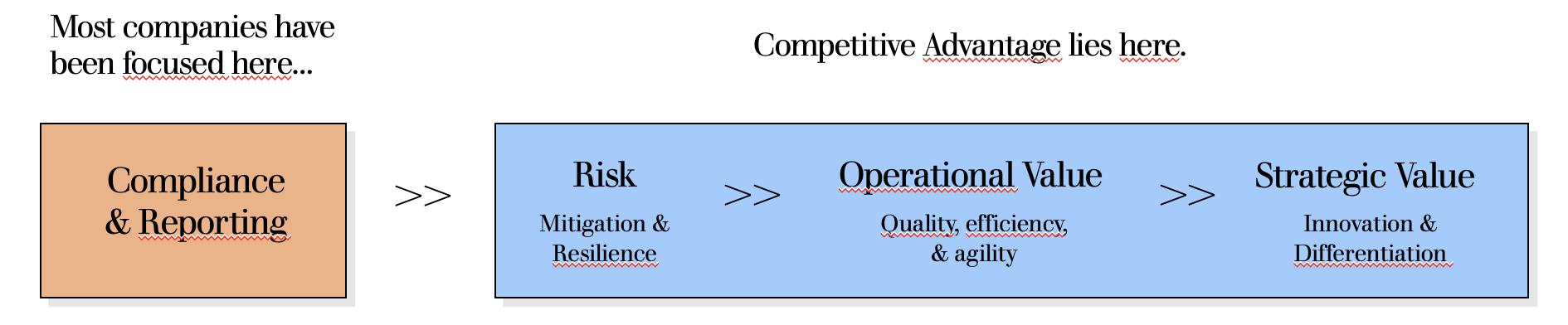
Agility converts insight into action at the speed the market demands. Yet most sustainability agendas have remained static, compliance-first, and slow to pivot. Sustainability is seen as a source of rigidity, with compliance-driven discussions blocking agile decision-making.
That must change. It's time to demonstrate how agility — the strategic and organizational capability to rapidly respond to market shifts and climate-related risks — can drive sustainable growth and propel the next stage of transformation. Now sustainability can be a way to unlock agility in business. It’s no longer just about what needs to change in our business to be more sustainable, but how we do it.
There are five dimensions that can guide CSOs and their teams in building agile, value-creating sustainability strategies.
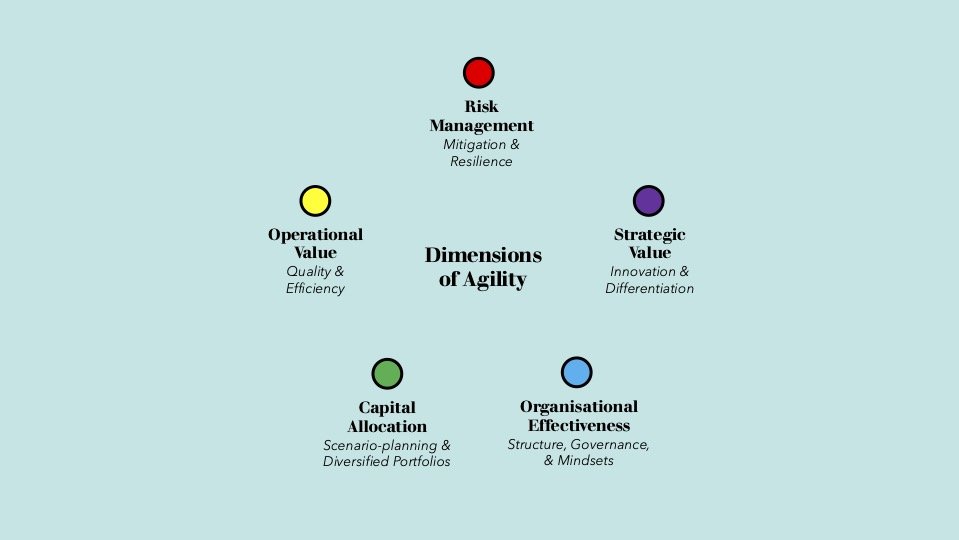
Risk management: mitigation and resilience
How are we designing resilience into our business and value chain so we can absorb and recover from disruptions faster than competitors?
How are we identifying and managing the most acute climate and nature risks to our business — including short-term energy and commodity shocks?
How are we monitoring and managing our dependencies on nature and developing strategies to deal with the potential deterioration or depletion of ingredients sourced from nature?
Operational value: quality, efficiency, and optionality
How are we managing the impact of climate — both long-term structural shifts and short-term shocks — on the quality and efficiency of our operations?
How are we building the organizational capability and supplier partnerships to share costs, de-risk transitions, or pivot our operations in response to new market and climate realities?
How are we coding optionality into our operational processes and supply chain network?
Strategic value: innovation and differentiation
How is our sustainability strategy shaping new business models for the future and enabling innovation rather than justifying legacy models?
How are we extending our reach through partnerships that expand our spheres of performance and impact?
How are we building brand equity that converts consumer concern into long-term loyalty?
Capital allocation: scenario-planning and diversified portfolios
Are we planning investments in around the full set of possible scenarios for the future of our business: market shifts, sourcing maps, access to energy and other key inputs?
How are we balancing the tension of maximizing short-term returns today versus investing in the sustainability solutions of tomorrow?
How are using our capital to diversify risk across geographies, societies, and production capabilities?
Organisational effectiveness: structure, governance, and mindsets
How are we enabling information flow and line of sight on key metrics across functions and geographies in our business?
How are we supporting the Executive team and Board to navigate the complex governance and decision making around sustainability topics in efficient, agile ways?
Are we equipping our teams with agility mindsets that can helps to understand how to both proactively manage risk and drive business value?
Agility as the Core Sustainability Capability
Ultimately, for sustainability to drive real competitive advantage it must be tied to market performance — either through value creation or risk mitigation. The companies that will lead the next decade are those that treat sustainability not as a static reporting exercise, but as a dynamic organizational capability: the ability to identify emerging climate, nature, and social-related risks and opportunities faster than competitors, and to act on them at speed. Of course stay compliant, but don’t let it hold the business back. Agility can help business leaders get beyond the rigidity of compliance-led sustainability strategy.
Agility is a cross-functional characteristic. Because sustainability teams have a unique cross-functional role and view on the business, they can and must, lead this discussion. This demands new ways of working: data-driven visibility into value-at-risk, coordinated cross-functional teams capable of accelerating sustainable innovation, and partnerships that expand a company's perspective and reach beyond its own value chain. It demands leaders willing to make bold moves when competitors are retreating — because retreating is itself a strategic choice, and rarely a winning one.
When agility becomes the organizing principle of a sustainability strategy, sustainability stops functioning as just a compliance exercise and becomes something far more powerful: a structural capability that equips companies to navigate uncertainty, outperform more brittle competitors, and define the markets of the future.
The energy crisis is once again reminding us what happens to companies caught flat-footed by volatility. Competitive advantage belongs to those building the organizational muscle to see it coming — and move.